Sunday, October 16, 2011

Softrock Ensemble II VHF

I finally started to build on one of my Softrock kits that I got lying here. My wife and son was away one Friday night and I could start building and continue uninterrupted for a few hours. It went smooth, apart from a problem soldering the Si570 where I thought that all three pads on each side where to be soldered together. No contact from the AVR to the Si570 so I just had to use the wick to remove some solder.  Two build sessions  after that and I could listen to the local repeater! A big thanks of course to Tony KB9YIG for providing the kits and Robby WB5RBZ for excellent build instructions. I still have some tweaking to do as the image rejection is not 100% but for now I consider this project done. I will now start with a Softrock receiver specially aimed for the Broadcast AM band. I will later make the same kind of enclosure to both these receivers.


Tuesday, August 30, 2011

80m BPF

A band-pass filter for 80 meter band.
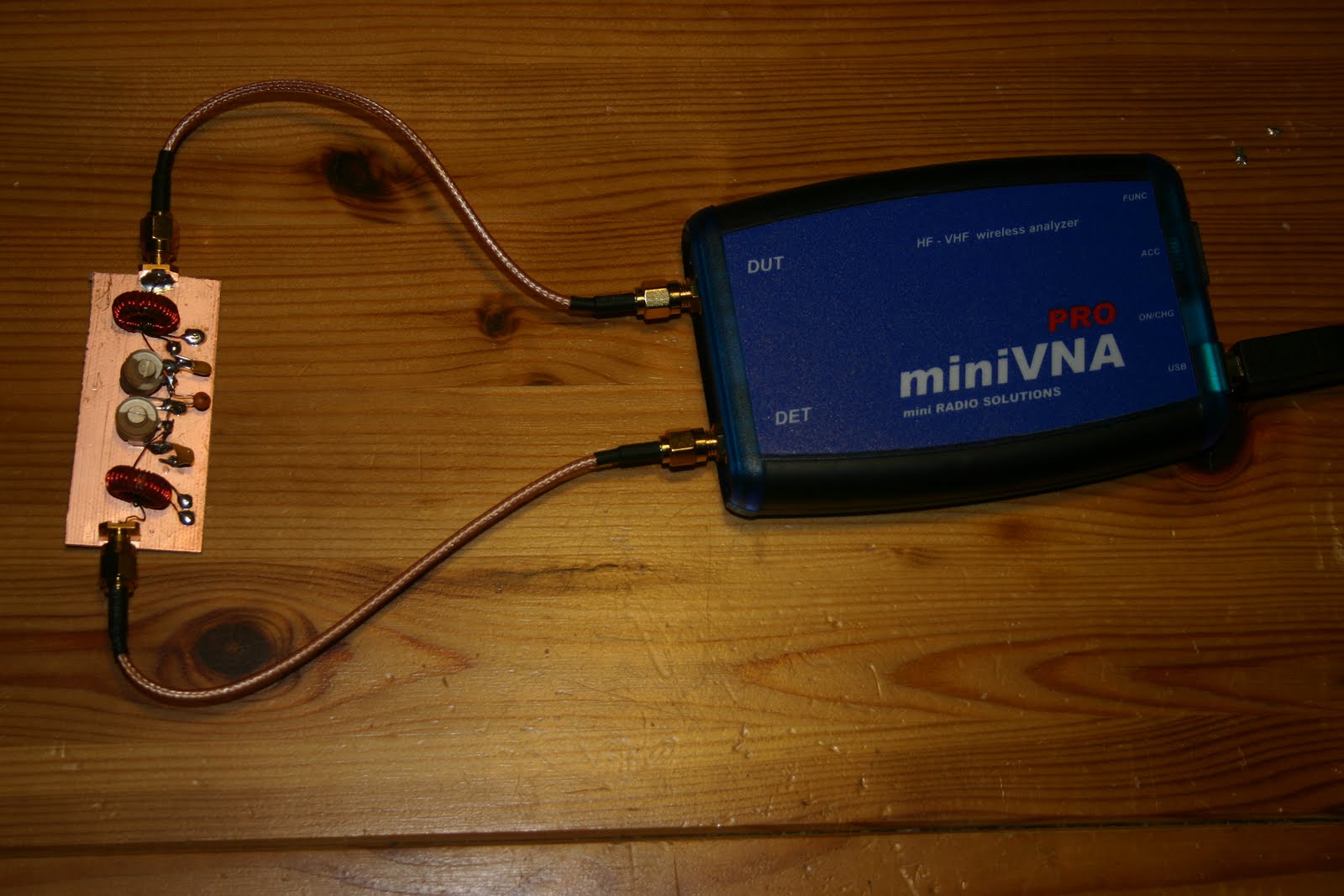
The simple direct conversion receiver I built a while ago works great when used daytime but on the evenings it will get overloaded by broadcasters. Maybe I can cure that with a better Band-pass filter. So I built one.  I used the values that I found at W8DIZ site, but with some variation to fit what I had in the junk box. As you can see it is built 'ugly' on a PCB. I am using SMA connectors as I was able to buy a large number that probably will last for many years to come.


Tuning and measuring the band pass filter with the MiniVNA Pro

Now using the miniVNA pro and the VNA/J software a can tune and align the filter as I want to have it. The nice thing is that you run the VNA continuously so I see right away on the screen how to filter looks like. This was the end result: 


VNA/J showing the 80 m BPF curve


Summer 2011


A long time since last entry in this blog. A summer with vacation and nice weather is now behind us. Some radio activity also and other news to mention.

Portable: I have been portable a few times during the summer. I have been participating in the Swedish Flora and Fauna activity. If you activate a Nature Reserve you might get a pile up on you which I now have tried for the first time. I also realized this summer that this contest and dx chasing part of this hobby is not a thing that I find important. It is the technical things and building stuff that is fun! But being portable has of course been a good time to try new antennas. I have built a few and I hope to write about them in later blog posts.

Oscilloscope: Some months ago I bought my first oscilloscope. It is a portable called DSO Quad. I have not used it enough so I can give a review, but according to the support forum it does not deliver according to the specification. Hopefully software patches can solve the problems...

Mini VNA Pro: I got a really nice birthday present some months ago, the Mini VNA Pro. An instrument that can measure on antennas, filters etc. The good thing with this one compared to other offerings is that I can use the VNA/J software in Linux.


Others: I have a few projects running now, like some more SDRs and maybe some rx / trx, but still not enough to tell anything about. I also play around with the Atmel AVR microprocessors, that is fun!


Sunday, April 3, 2011

Simple direct conversion receiver - MRX-80

I have built my first analog receiver! This is maybe one of the simplest ones you can build ( a crystal radio might be simpler depending on how you count). The direct conversion receivers basically mixes the incoming signal with the local oscillator and the result is within frequency for our ears. The classic basic combo of ICs, NE602 and LM386 are used. The circuit is from the book "More QRP Power" from ARRL and is called the MRX-80. As you might guess it is for 80 m. 


The build is done inside an old box used for an Ethernet network hub. The BNC connection hole was already there but I had to to use a side of PCB material so I could mount the pots for gain and tuning. Yes, talking about the tuning, it is somewhat limited. I can change crystals and a diode is used as a varactor so a small swing of frequency is allowed, but I have not yet measured how big this is, maybe 1 kHz or so. The build is a mostly with leaded parts built ugly/Manhattan but all resistors are tiny 0805 smd, just because I wanted to try and see if it works. Maybe it does or probably not completely.  The build is not the prettiest, but if you see any bad choices of building other than aesthetic, please comment or if you have any other comments.

When I turned it on, the first thing I did was to measure the voltage out from the regulator. OK! I then turned my small Degen 1103 radio on and listened for the local oscillator. It was loud and clear so OK on that too! Then I connected my signal generator, but nothing heard, apart from noise. I started tapping on some connection and I heard them. So I guess the audio amp was working too.  Hmm, I started double checking other connections and soon found that I had connected earth connections between antenna and gain pot but not to the real earth on board. Then my test signal could be heard. When put in S9 mode it was OK, but not in S1. I wonder about what to expect from this simple thing. The real test will of course be when I try it with a decent antenna and see if I can hear any real on the air signals. 

I might have heard some today, or maybe not, because I never checked if they were present on another receiver. Next weekend I will go out to a 'quiet' place and listen. 

Below is a audio recording. Some signal can be heard, but QRM level is high so much noise. It does not sound as what I am used to what a radio should sound like. Either this is what a direct conversion receiver sounds like or I have some construction errors. I will bet on the last one. 


The sum up, a good build I think. Fun to do and easy. First small steps and more experience in radio homebrewing!

Update 2011-07-15:
The receiver has worked fine and the signal on the recording is SL0FRO by the way SM5-1252 Ullmar told me. 

Softrock Linux software

I have been using my little Softrock lite II SDR receiver on 30 m now for a while together with the SDR-Widget. I can only say that this little setup works great! Initially I tested it with Windows software (see previous post) but I want be in the Linux world. There are different software available to use with the Softrock receiver and the SDR-Widget. So far I have tried two, Quisk and GHPSDR3. As the SDR-Widget is cable of running in different setups (USB Audio version 1/2 and HPSDR) it was a great step forward when a unified firmware was released so that I can flip between them with just a 'reboot' of the SDR-Widget, compared to doing a real reflashing of firmware.

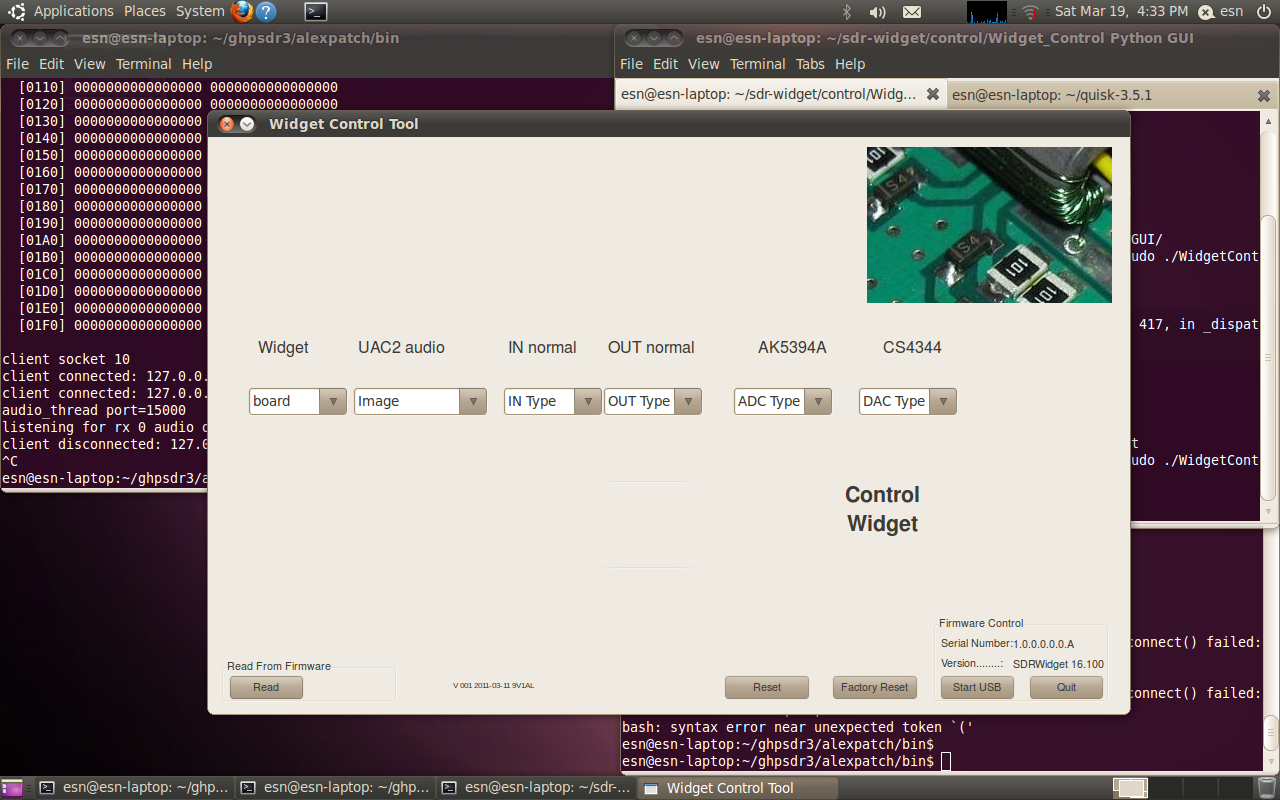
SDR-Widget control software
Below is a screenshot of Quisk with 192 kHz sample rate.
Quisk
I have also tried the HPSDR protocol and the gHPSDR3 suite of software. The first screenshot is QtRadio, which I think is the most recent software in this still developing suite of software. The great thing with this is that is built for network use. A software called dspserver is running on one computer and the GUI on another (but they could of course be on the same box). Over the network the audio and screen updates is sent. I have also let others try the minimal GUI called jmonitor over the Internet! I will try these software a lot more in the future.

In this case I was using just a wire inside my apartment so a lot of QRM but there are a few CW signals that I am able to listen to.
QTRADIO
Ghpsdr is another software:
GHPSDR3
Finally some pictures of the Softrock in a box  (Ikea as usual):


This is when I tried it at the club station: