The user interface is via CW and I have not yet programmed it for beacon use. When I put it that service I can just move the chip over. We will see when that happens. So many interesting projects going on at the same time. This is a fun hobby!
Friday, March 23, 2012
CW keyer
I have built a CW keyer. I can not copy CW very well but the main use for this one is for a beacon. I also added the 'paddles' to the circuit, but that is just for testing it out and not so practical to use. I searched around a bit to try to find a suitable software. I wanted it to be open source software and use an Atmel MCU. So I found http://lategahn.2log.de/index.php?yack-yet-another-cw-keyer . It is basically just a few components, Attiny45, voltage regulator and a piezo buzzer . Here is a video:


Thursday, March 15, 2012
Equipment Update

Just a small post about two recent purchases. First a 3 Ampere lab power supply and then an oscilloscope: Rigol DS1052E 50 MHz digital scope. And if you wonder, the black box between them are the QS1R SDR, 0-62 MHz receiver and spectrum analyzer. I starting to feel quite well equipped.. :-)
Thursday, March 1, 2012
Building Ham Radio Subway style
I saw the above video by Tom AK2B where he shows what he calls subway style of building. I wanted to try it so I bought a drill bit that is supposed to be used for wood and modified it a bit so that when making the 'islands' the drill bit will not go through the PCB. Below is an image of the latest project, an audio amplifier where I tried this. The image is taken in the middle of the build process so you can see some unused pads.

The result was very good and I will probably continue to use it. Here is a video with the audio amp is being tested:
BTW, the music is Motor City Drum Ensemble with Stuttgart Nights!
Wednesday, January 4, 2012
PCB holder kit


I just got this kit in the mail. It is a simple and quite handy PCB holder from Ken WA4MNT. Get more information and buy at http://qrpbuilder.com/ .
Friday, December 2, 2011
Unfinished and ongoing projects 2011
I haven´t posted in a while. I usually have posted when something is more or less done. So the conclusion of that would be that I got a few projects going now that I have not finished. So just to have something to post here on the blog I thought that I could describe a few of them. The main project right now seems to be the remote RX I have online and we are a group of people sharing it. That project deserves a separate post.
These are a few of the projects that I have started and not finished yet. I think I list them in priority order below.
A step attenuator
The first project is a step attenuator. I use 1206 resistors. I have measured the SWR through it (without any attenuation on) and see a rising SWR and at 30 MHz it is 1:13. Quite high? Any readers could give a comment on what could be wrong. Is it just the switches and the zigzag between them that changes the impedance?
I use a box that used to have Mackerel fillet in tomato sauce in it.. :-)
HF Test set
This is a kit that I bought a while ago. It is from the 4 State QRP Group. It will become Frequency Counter, Crystal Oscillator, Wideband Noise Generator, Audio Oscillator, 50 Ohm Dummy Load, RF Probe and Time Domain Reflectometer. I started to build and finished about up to 50% of it and then got diverted into other projects. A got a nice enclosure and a back lit LCD here to be used for the project.
Watt meter
This project is also finished to about half. The AVR is soldered to the board and LCD is tested as seen in the picture. I was happy that the first time ever I soldered a TQFP32 was success!
I have also done the input part and measured it with the VNA. Next step is the AD8307 IC. I am following the guide here:
http://lategahn.2log.de/index.php?A-minimalistic-500MHz-Wattmeter
10m CW beacon
I got the PCB for the Genesis Radio Q5 transmitter some year ago. What I did not have was the final transistor but I received one of those last month. My idea is to build a beacon for the 10m band. I have built and tested the oscillator. The PA stage is built as can seen on the image, but not tested yet. To be built is the LPF and the beacon keyer. I think I will use an attiny45 together with the code from YACK
I could probably run it on my balcony if I come up with an antenna. Might be a loop.
30m QRSS beacon
This projects started earlier this year. I bought a few ATTINY13 IC:s and programmed to IC, I thought. When testing the oscillator it was ok, but no keying from the attiny. I then thought I should get another programmer. I have it here, but I have not got back to the build. It will be later.... Together with this I also started to build a DCTL antenna after reading about it a http://draaggolf.blogspot.com/ . I also got some good advice from Joachim but have not finished it either......
MKARS80
I bought the kit quite a while ago and started the build. Then I thought it would be more fun to build simpler things and not necessarily kit. As the build instuctions did not include any testing along the way, everything just felt like a soldering practice. But I have to finish it. Might be good to have a goal set for summer 2012 so I can run it portable.
These are a few of the projects that I have started and not finished yet. I think I list them in priority order below.
A step attenuator
The first project is a step attenuator. I use 1206 resistors. I have measured the SWR through it (without any attenuation on) and see a rising SWR and at 30 MHz it is 1:13. Quite high? Any readers could give a comment on what could be wrong. Is it just the switches and the zigzag between them that changes the impedance?
I use a box that used to have Mackerel fillet in tomato sauce in it.. :-)
 |
| Step attenuator progress |
HF Test set
This is a kit that I bought a while ago. It is from the 4 State QRP Group. It will become Frequency Counter, Crystal Oscillator, Wideband Noise Generator, Audio Oscillator, 50 Ohm Dummy Load, RF Probe and Time Domain Reflectometer. I started to build and finished about up to 50% of it and then got diverted into other projects. A got a nice enclosure and a back lit LCD here to be used for the project.
 |
| NB6M HF Test Set (not built by me) |
Watt meter
 |
| AVR with LCD for the AD8307 Watt meter |
This project is also finished to about half. The AVR is soldered to the board and LCD is tested as seen in the picture. I was happy that the first time ever I soldered a TQFP32 was success!
I have also done the input part and measured it with the VNA. Next step is the AD8307 IC. I am following the guide here:
http://lategahn.2log.de/index.php?A-minimalistic-500MHz-Wattmeter
10m CW beacon
I got the PCB for the Genesis Radio Q5 transmitter some year ago. What I did not have was the final transistor but I received one of those last month. My idea is to build a beacon for the 10m band. I have built and tested the oscillator. The PA stage is built as can seen on the image, but not tested yet. To be built is the LPF and the beacon keyer. I think I will use an attiny45 together with the code from YACK
I could probably run it on my balcony if I come up with an antenna. Might be a loop.
 |
| Genesis Radio Q5 CW transmitter |
30m QRSS beacon
 |
| QRSS transmitter for 30m |
MKARS80
I bought the kit quite a while ago and started the build. Then I thought it would be more fun to build simpler things and not necessarily kit. As the build instuctions did not include any testing along the way, everything just felt like a soldering practice. But I have to finish it. Might be good to have a goal set for summer 2012 so I can run it portable.
Sunday, October 16, 2011
Softrock Ensemble II VHF


Tuesday, August 30, 2011
80m BPF
 |
| A band-pass filter for 80 meter band. |
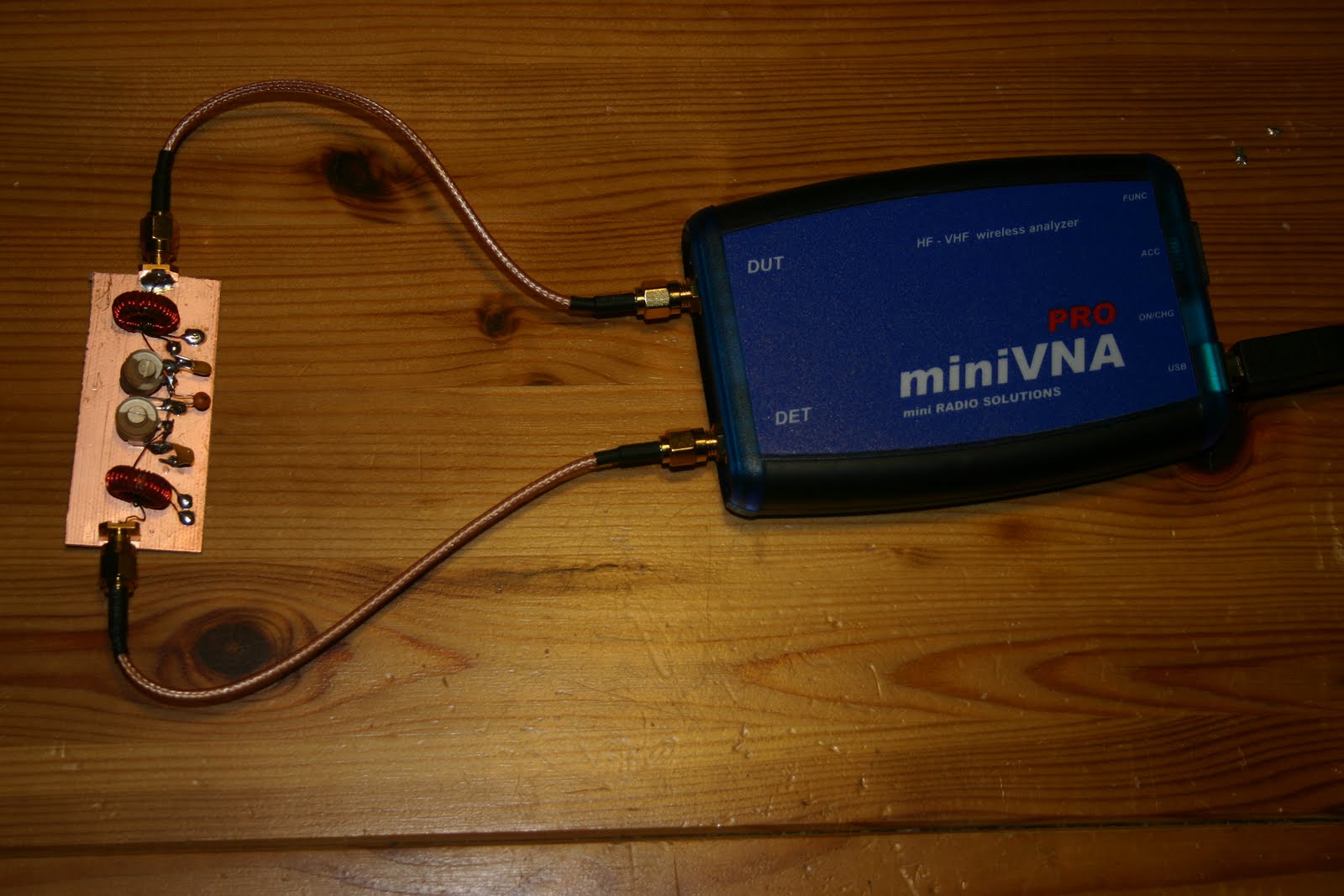 |
| Tuning and measuring the band pass filter with the MiniVNA Pro |
Now using the miniVNA pro and the VNA/J software a can tune and align the filter as I want to have it. The nice thing is that you run the VNA continuously so I see right away on the screen how to filter looks like. This was the end result:
 |
| VNA/J showing the 80 m BPF curve |
Summer 2011
A long time since last entry in this blog. A summer with vacation and nice weather is now behind us. Some radio activity also and other news to mention.
Portable: I have been portable a few times during the summer. I have been participating in the Swedish Flora and Fauna activity. If you activate a Nature Reserve you might get a pile up on you which I now have tried for the first time. I also realized this summer that this contest and dx chasing part of this hobby is not a thing that I find important. It is the technical things and building stuff that is fun! But being portable has of course been a good time to try new antennas. I have built a few and I hope to write about them in later blog posts.
Oscilloscope: Some months ago I bought my first oscilloscope. It is a portable called DSO Quad. I have not used it enough so I can give a review, but according to the support forum it does not deliver according to the specification. Hopefully software patches can solve the problems...
Mini VNA Pro: I got a really nice birthday present some months ago, the Mini VNA Pro. An instrument that can measure on antennas, filters etc. The good thing with this one compared to other offerings is that I can use the VNA/J software in Linux.
Others: I have a few projects running now, like some more SDRs and maybe some rx / trx, but still not enough to tell anything about. I also play around with the Atmel AVR microprocessors, that is fun!
Sunday, April 3, 2011
Simple direct conversion receiver - MRX-80
I have built my first analog receiver! This is maybe one of the simplest ones you can build ( a crystal radio might be simpler depending on how you count). The direct conversion receivers basically mixes the incoming signal with the local oscillator and the result is within frequency for our ears. The classic basic combo of ICs, NE602 and LM386 are used. The circuit is from the book "More QRP Power" from ARRL and is called the MRX-80. As you might guess it is for 80 m.


The build is done inside an old box used for an Ethernet network hub. The BNC connection hole was already there but I had to to use a side of PCB material so I could mount the pots for gain and tuning. Yes, talking about the tuning, it is somewhat limited. I can change crystals and a diode is used as a varactor so a small swing of frequency is allowed, but I have not yet measured how big this is, maybe 1 kHz or so. The build is a mostly with leaded parts built ugly/Manhattan but all resistors are tiny 0805 smd, just because I wanted to try and see if it works. Maybe it does or probably not completely. The build is not the prettiest, but if you see any bad choices of building other than aesthetic, please comment or if you have any other comments.
When I turned it on, the first thing I did was to measure the voltage out from the regulator. OK! I then turned my small Degen 1103 radio on and listened for the local oscillator. It was loud and clear so OK on that too! Then I connected my signal generator, but nothing heard, apart from noise. I started tapping on some connection and I heard them. So I guess the audio amp was working too. Hmm, I started double checking other connections and soon found that I had connected earth connections between antenna and gain pot but not to the real earth on board. Then my test signal could be heard. When put in S9 mode it was OK, but not in S1. I wonder about what to expect from this simple thing. The real test will of course be when I try it with a decent antenna and see if I can hear any real on the air signals.
I might have heard some today, or maybe not, because I never checked if they were present on another receiver. Next weekend I will go out to a 'quiet' place and listen.
Below is a audio recording. Some signal can be heard, but QRM level is high so much noise. It does not sound as what I am used to what a radio should sound like. Either this is what a direct conversion receiver sounds like or I have some construction errors. I will bet on the last one.
The sum up, a good build I think. Fun to do and easy. First small steps and more experience in radio homebrewing!
Update 2011-07-15:
The receiver has worked fine and the signal on the recording is SL0FRO by the way SM5-1252 Ullmar told me.
Softrock Linux software
I have been using my little Softrock lite II SDR receiver on 30 m now for a while together with the SDR-Widget. I can only say that this little setup works great! Initially I tested it with Windows software (see previous post) but I want be in the Linux world. There are different software available to use with the Softrock receiver and the SDR-Widget. So far I have tried two, Quisk and GHPSDR3. As the SDR-Widget is cable of running in different setups (USB Audio version 1/2 and HPSDR) it was a great step forward when a unified firmware was released so that I can flip between them with just a 'reboot' of the SDR-Widget, compared to doing a real reflashing of firmware.
Below is a screenshot of Quisk with 192 kHz sample rate.
I have also tried the HPSDR protocol and the gHPSDR3 suite of software. The first screenshot is QtRadio, which I think is the most recent software in this still developing suite of software. The great thing with this is that is built for network use. A software called dspserver is running on one computer and the GUI on another (but they could of course be on the same box). Over the network the audio and screen updates is sent. I have also let others try the minimal GUI called jmonitor over the Internet! I will try these software a lot more in the future.
In this case I was using just a wire inside my apartment so a lot of QRM but there are a few CW signals that I am able to listen to.
Ghpsdr is another software:
Finally some pictures of the Softrock in a box (Ikea as usual):

This is when I tried it at the club station:

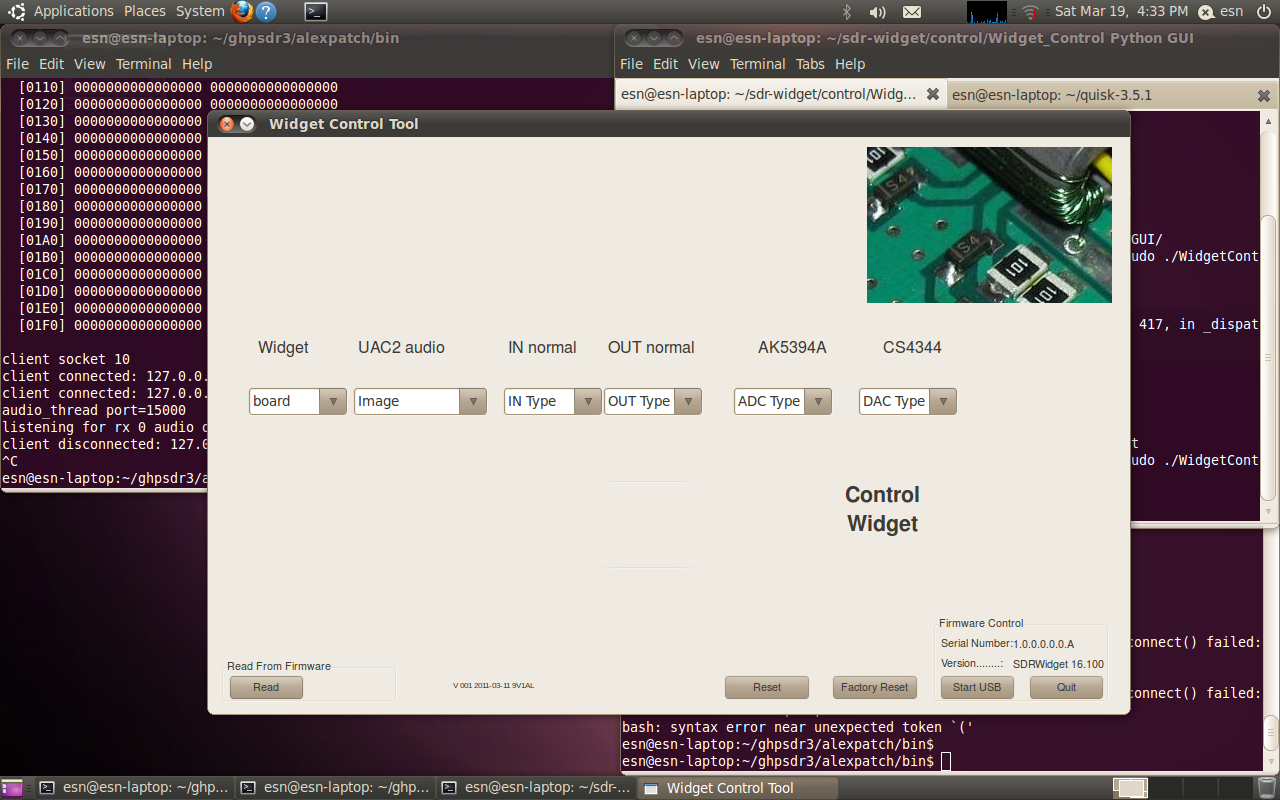 |
| SDR-Widget control software |
 |
| Quisk |
In this case I was using just a wire inside my apartment so a lot of QRM but there are a few CW signals that I am able to listen to.
 |
| QTRADIO |
 |
| GHPSDR3 |

This is when I tried it at the club station:

Monday, February 21, 2011
Softrock Lite II receiver for 30 m
Finally. I´ve had this SDR kit in my drawer for over 1 year, but now it´s built and seems to be working fine.
Below a few pictures. As it´s late and my antennas is nothing to talk about here in the apartment, 30 meter is dead. So I´m using the signal generator that I described earlier. I of course want to use Linux but as Rocky seems to be the software suggested to start with I wanted to lower the numbers of 'unknowns' and get it running. And it did! The mirror images was easily suppressed. Below is a picture of WRPlus that I tried after Rocky:


 The SDR-Widget is now housed in a box, temporarily. I have not flashed the firmware yet to allow 192 kHz usage. Will do that later, when I will try to get it running in Linux.


Below a few pictures. As it´s late and my antennas is nothing to talk about here in the apartment, 30 meter is dead. So I´m using the signal generator that I described earlier. I of course want to use Linux but as Rocky seems to be the software suggested to start with I wanted to lower the numbers of 'unknowns' and get it running. And it did! The mirror images was easily suppressed. Below is a picture of WRPlus that I tried after Rocky:

Here are two pictures of the temporary test setup...


 The SDR-Widget is now housed in a box, temporarily. I have not flashed the firmware yet to allow 192 kHz usage. Will do that later, when I will try to get it running in Linux.
And to end with, some close up pictures on the board. The coax connection isn´t the prettiest, but it seems to work while testing. I will have do redo that when I put in a permanent box.


My SMD soldering skills has been improved and now I feel confident to go ahead with other bigger project.
Monday, January 31, 2011
SDR-Widget arrived
The SDR-Widget that I wrote about some months ago arrived today. I just unpacked and here is a few pictures:


I am really looking forward getting into this. The little problem I got is that I do not have any Softrock SDR to use it with right now. So it will be used as a normal sound card for a few days.
But I actually have both the Softrock Lite II and Softrock RXTX 6.3 here to be built. They have been in my drawer now for more than half a year but some days ago I started building again on the lite for 30m and no problems so far. I even managed to solder the SOIC chips ! I have been using the QS1R receiver that is some what more expensive SDR than these for some years now, but I really looking forward to use a radio that I have built myself and using only open source software !


I am really looking forward getting into this. The little problem I got is that I do not have any Softrock SDR to use it with right now. So it will be used as a normal sound card for a few days.
But I actually have both the Softrock Lite II and Softrock RXTX 6.3 here to be built. They have been in my drawer now for more than half a year but some days ago I started building again on the lite for 30m and no problems so far. I even managed to solder the SOIC chips ! I have been using the QS1R receiver that is some what more expensive SDR than these for some years now, but I really looking forward to use a radio that I have built myself and using only open source software !
Saturday, January 22, 2011
A 20 W Dummy Load
This time I have built a dummy load. I got this design from Elecraft. It is 8 100 ohm resistors rated for 3 W each. 4 in parallel first that gives 25 ohm and then in serial with another batch, so in total 50 ohm. I can also measure the voltage and use a graph to find the corresponding power. Max power should be 20 W.
Here is a few pictures:


Here is a few pictures:


And by the way, the box is from IKEA.
Monday, January 17, 2011
Test equipment - LC and multi

The number of test equipment here continues to grow. This time it is a LC meter. The circuit I built is more or less similar to this one:
http://ironbark.bendigo.latrobe.edu.au/~rice/lc/
A big thanks to Göran SM5AWU that had a kit with components that I bought. He also had done the PCB and drilled the holes for me.

I have also bought me a new multimeter. It´s the Vichy VC99 made in China. I bought it on Ebay for $30 including shipping. It has a few more features compared to the one I had before, like auto ranging, frequency counter, transistor and diode testing etc. It´s a little bit too plastic to feel really good, but at a good price I guess. I have not used it so much so far, but already found some minor issues, like it beeps very loud when it auto shut downs and the continuity tester is slow compared to the old multimeter. Maybe I can change the first behavior if I read the manual. I will continue to use both of them. A good buy overall!

Monday, November 22, 2010
Simple signal generator
With a little bit of inspiration from the blog of M0XPD I have built a simple signal generator. The original design is from NorCal QRP club and can be found here. I´m able to create a S1 or S9 signal (more about the s level here) that I can listen to if I´m going to test a receiver. I can change between 4 different crystals/frequencies. As there is no low pass filtering in the circuit there will also be harmonics. Here is two pictures and you can see that it´s been a while since I built it but haven´t documented it until now.


The box by the way is bought at IKEA. I think it was 7 different boxes in one set and quite cheap. Next test equipment in the blog will use one from that set too.


The box by the way is bought at IKEA. I think it was 7 different boxes in one set and quite cheap. Next test equipment in the blog will use one from that set too.
Sunday, November 21, 2010
Linux and LTspice

I finally changed over (or should I say back) my main desktop to Linux. This time it is 64 bit Ubuntu 10.10. I have been running Linux for the last 15 years or so, but changed to Windows some year ago and one of the reasons was that the SDR software I wanted to use was only available for Windows. But now I felt it was time to go back. I have not run Ubuntu earlier, previously it has been Slackware, Debian and OpenSuse (in that order in time), but I can only say that I am impressed with Ubuntu today. Everything worked "out of the box". No fiddling with drivers as it has been in the past.
This Saturday I attended a meeting in the ham club with the topic LTspice. If you have not heard about it earlier, it is a software that can simulate circuits. A very good tool I think. The introduction was held by Volker SM5ZBS. You can check out his homepage. It is in German but I think it is interesting and can be translated if needed. On the screen above you see my new Ubuntu desktop and LTspice which is a Microsoft Windows software is running. You may ask how that works? It is running in Wine, a tool in Linux that makes it possible for some Windows software to run in Linux. Works great!
By the way, the circuit that I have laid out is a audio filter I found in chapter 15 in the book CRYSTAL SETS TO SIDEBAND by Frank W. Harris, KØIYE. It a free download as everything I mentioned in this post!
Monday, November 15, 2010
20m antenna and remote listening
I´ve been having some fun during last couple of days. I live in an apartment where I don't have that much of space for antennas and regular radio activity. But at a relatives house where a lot of trees is available I´ve been playing around a bit. I have been here some year ago and at that time I was laying out BOGs (Beverage on ground) antennas and I was DXing for AM stations in South America, but this time I wanted to focus on the amateur radio bands and in this case the 20m band. One easy antenna to build is a vertical using stubs to get a good match that I learnt about from SE5X. The radiator element was around 10 meters that I throw up in a tree.

If you would like to build this antenna, this PDF from SM0JZT describes the lengths of each segment. It´s in Swedish but I think you will understand if you are interested. Otherwise let me know via the comments.
When everything was installed last Monday it had went dark so 20m started to close and I never got a QSO. Instead I setup the QS1R and prepared for remote listening via LogMeIn Pro.
Below is a capture taken on my home computer. I have connected to the LogMeIn server via the web browser so this is the experience I got. The connection is a quite slow ADSL so I set the update rate of the waterfall to a slow setting. As this was done late when 20m was dead, this is 40m.
I went back on Thursday lunch last week and had one QSO with M3GFQ on 20m. I got 59 and I think that was a true report. :-)
Hopefully soon the new software for QS1R will be available. This will make it possible to run the server part remote and the GUI at home and be able to record RF to disk. I actually don´t feel so good about paying for this remote solution from LogMeIn, but as this opportunity to have the remote QS1R came up and I didn´t have time to setup streaming audio (open ports in firewall etc.) the Logmein solution is really working well. With new QS1R software I can hopefully use Linux instead of Windows. Remote QTH saga will continue...

If you would like to build this antenna, this PDF from SM0JZT describes the lengths of each segment. It´s in Swedish but I think you will understand if you are interested. Otherwise let me know via the comments.
When everything was installed last Monday it had went dark so 20m started to close and I never got a QSO. Instead I setup the QS1R and prepared for remote listening via LogMeIn Pro.
Below is a capture taken on my home computer. I have connected to the LogMeIn server via the web browser so this is the experience I got. The connection is a quite slow ADSL so I set the update rate of the waterfall to a slow setting. As this was done late when 20m was dead, this is 40m.
I went back on Thursday lunch last week and had one QSO with M3GFQ on 20m. I got 59 and I think that was a true report. :-)
Hopefully soon the new software for QS1R will be available. This will make it possible to run the server part remote and the GUI at home and be able to record RF to disk. I actually don´t feel so good about paying for this remote solution from LogMeIn, but as this opportunity to have the remote QS1R came up and I didn´t have time to setup streaming audio (open ports in firewall etc.) the Logmein solution is really working well. With new QS1R software I can hopefully use Linux instead of Windows. Remote QTH saga will continue...
Friday, October 22, 2010
SDR-Widget
I just preordered the BETA version of the upcoming SDR-Widget. This is basically a sound card designed by a group of radio amateurs specifcally to be used in Software Defined Radios based on the quadrature sampling detector scheme, i.e. a souncard is needed in opposite of the Digital Down Conversion scheme where an special ADC chip is doing the analog to digital conversion. I am excited about this and hope this will be a great success!
Hardware Features:
 |
| An early alpha version of the SDR-Widget |
- Compact 3" x 2.5", 2 board stack. 3.5mm audio connections.
- Powered from the USB port, no external power supply needed
- 24-bit AK5394A ADC - the premier audio ADC in commercial use today
- CS4344 24-bit DAC
- I2C control bus
- 16-bit LCD panel interface (configured for 4-bit) with drivers for HD44780 based 4-line displays
- Connector for quadrature rotary encoder input (with push switch)
- 3 optocoupler buffered inputs
- 3 mosfet 'contact' outputs
- Firmware update via USB port
- JTAG port (connector not mounted)
- USB composite device with audio I/O, control and CDC channels
- Supports USB Audio class 2 (480mbs) on the latest Linux kernel as well as the latest Mac OS
- Support 24-bit 48k/96k/192k sample rates on Linux and MacOS
- Support USB Audio class1 on Windows at 48k sample rate. NOTE: Windows does not support UAC2
- Has an integrated CDC, Communications Device Class, channel for debug messages
- A superset of the DG8SAQ control interface
- 4-line LCD message engine
- Menu system with selection control via external rotary encoder and switch.
Go here: http://groups.google.com/group/sdr-widget to get more details!
Sunday, September 19, 2010
Active on the HF bands

During last week of August me and my second operator visited my parents and there was a Icom 707 for me to borrow, so why not try some QSOs on the shortwave bands for the first time ever. I operated as SA5BKE/4 and made around 15-20 QSOs around Europe on 80 m up to 17 meters. Great fun! I also promised to send out some QSLs but haven´t made any attempts yet. I am thinking about making some custom ones with this method.

Some week later I saw a Kenwood TS-450SAT for sale at a good price. As it was only 30 minutes drive from here I went there and took a look. Seemed to be a nice rig so I bought it! On 12 September I could try it with my 15,5 m longwire on 4 m height with my home made 9:1 unun. I only made 2 QSOs on 80 m and 17 m, but everything seemed to be fine business. I used a car battery but I now started to look for a power supply. Maybe I find a good one on the upcoming ham radio flea market here in Norrköping in a couple weeks or maybe try to convert a PC power supply?
Sunday, August 29, 2010
Summer

Summer of 2010 has been one of the better ones. Very pleasant weather and I have been home with my son for a couple of months. It has not been that much time for radio. I have done some listening and few times been working on some test equipment, but that will be covered in a post within a few weeks. I have also had my HF band debut, but I give a report on that within in some day or so.
Here are some other points from the last months:
I have mentioned earlier some interference problem when using the QS1R SDR receiver. One easy solution that I tried and seemed to work was to solder a connector to the 5 V connection in the PC power supply. A lot cleaner than the switching power supply I used earlier. Old PC power supplies can be had for free so maybe I should take use of them more. I also plan to make a 12V->5V regulator to try to run the QS1R from batteries together with the laptop.
A 9:1 un:un for random longwires has been made. See image below. No transmitting with it yet.

Texas Instruments has released a micro controller development board called Launch Pad . It was available for $4, so I ordered one. Maybe they want to compete with Arduino ? The package came and below is a photo of the content. I have not played with it much yet.

I do some shopping on Ebay and mostly from far east. My understanding has been that when I order cheap stuff with low or no shipping cost I take the risk if it gets lost. I ordered some parts from Thai Shop Etc and when I hadn´t received it within a month I started to think I was "scammed". But when I contacted them they said they either will refund me or send the stuff again. I choose the latter and within a week I had it in my hands. Very good service! So I would say that I recommend them.
and last:
The Medium Wave DX season 2010-11 has started when I received some common stations from North American on the 21 August. 1130 WBBR, New York as always the strongest.
Subscribe to:
Posts (Atom)